Friday, 14 August 2015

Rejoicing at Rock Union Church!


I have always had an affinity for country churches, and our area is blessed with several excellent examples.  One of the most quaint ones has to be the stately but simple stone structure known as the "Rock Union Church" sitting quietly on the corner of Lot 12, Concession 7 in the former Collingwood Township.  

In the mid 19th century, there was originally a small church constructed of logs on the property.  On January 7th, 1898, the Methodist trustees sold the one quarter acre of land and the log church to the trustees of the new union church.  The recipients of this deed were Jesse James, Thomas McKinley and William Henry Johnson, all local residents of the area.  Interestingly enough, some 80 years later, the trustees of the church were still in the names of of James, McKinley and Johnson, descendants of the original trio.  Discussions were held on the construction of a new church, and in mid 1898 the building was completed using stone quarried from Malcolm McArthur's nearby farm.  Credit for the name was given to Mrs. Walter Buchanan who was a well known local poet.

As befitting it's name, it was known to be a "union church" of all denominations.  From the date of it's construction in 1898 until 1962, regular church services were held here.  Once a year an annual service is held to bring together the old families of the area for one day of worship and fellowship, and occasionally a wedding or two as well.  The church is still immaculately maintained, and is a wonderful place to stop and pause for a moment or two of quiet reflection.  It is also blessed with amazing acoustics, something that always gives me ample cause to sing a song.  I know summer typically isn't the time of year one usually sings a Christmas song, but somehow I thought an impromptu singing of "Oh Holy Night", one of my most favourites was wholly appropriate for this very special place.  Please check out my website at http://sandym70.wix.com/minimal-artist-portf.

I hope you enjoy this post, and hopefully my song as well!


Tuesday, 28 July 2015

Wednesday July 29th, 1981, Diana's 34th wedding anniversary


Thirty four years ago today, a shy young girl walked down the aisle and into the annals of history.  As an estimated 700 million people around the world watched, little did we or Lady Diana Spencer know that decision would forever alter her life and her fate.  

 From the first moment I saw Diana on the cover of MacLean's magazine as a young girl of 19, I as we all no doubt were, was captivated by her beauty, her shyness,  and her charmingly endearing personality.  Over the course of 17 years, we all watched and shared in her journey, as she progressed from a shy bride to a confident and glamorous woman the likes of whom we never see again.  Unfortunately though, the road for her wasn't to be a smooth one.  Her "fairy tale" contained an unfaithful prince, an eating disorder, and unyielding self doubt all played out under the unrelenting glare of the spotlight as she became the most photographed individual of modern times.

Through it all though, she raised two wonderful boys, William and Harry, while at the same time crafting a role for herself in an archaic and somewhat medieval monarchy.  Not only did she eclipse her wayward husband in popularity, the shy former schoolteacher blossomed to eventually overshadow the rest of the Royal family as well.  Although this caused massive dissension amongst the ranks,  her refreshing and relaxed attitudes are actually credited with modernizing the attitude of the British royals, and ultimately leading them to a resurgence popularity.  Her dedication and love for people was unabashedly pure, and her dedication to serving her country without question.  She was one the patron of more than 100 charities, and eventually paired this down to the 10 of which she was most passionate as she sought an exit and eventually a divorce from Prince Charles and the Royal Family.

After her divorce was granted in 1996, it seemed as if Diana was finally free to pursue her own destiny in life.  She dedicated herself to her remaining stable of charities, her newfound interest in the abolition of land mines, and of course her sons.  Although it is reported she had several romantic interests, most seemed fragile and doomed due to the unrelenting publicity of the press.  In fact, few folks would realize that the world's most famous woman spent many nights home alone, watching television or sitting at her desk working on correspondence.  

There has been much conjecture on the details of her relationship with Dodi Fayed with whom she was involved in the summer of 1997, but most of those closest to her have steadfastly maintained that this was but a "summer fling" for Diana. Unfortunately however, this erstwhile coupling was to ultimately seal her fate.  In the early hours of August 31st, 1997, Diana, Dodi, their security officer Trevor Rees Jones, and driver Henri Paul were involved in a fatal accident while under the pursuit of photographers in Paris France.  Their Mercedes crashed into the 13th pillar of the Pont de  l'Alma tunnel under the Seine River.  Dodi and Henri Paul died instantly, Trevor Rees Jones was seriously injured, and the most famous and beloved woman of our times succumbed to her injuries a few hours later in a Paris hospital.  She was 36.  The fairy tale begun 17 years ago had come to a tragic end.

A week later Diana was honoured with a state funeral at Westminster Abbey.  Almost as many people gathered to bid her farewell as had there been for her wedding.  William and Harry, their father Prince Charles, and Diana's brother, the Earl Charles Spencer along with the representatives of more than 100 of her favourite charities followed along with her casket as a horse drawn carriage brought it to the Abbey.  Diana was laid to rest on an island at Althorp, her childhood home and the Spencer Estate in Northamptonshire.  Somewhat ironically, the name "Diana" refers to the "goddess of the hunt."  The most hunted woman of modern times was finally free at last.


As I said before, I adored Diana and was fortunate enough to meet her several times during their Canadian tour of Canada in the autumn of 1991.  My mom Mary was with me, and the first place we met her was at Nathan Phillips Square in Toronto on Friday October 25th, 1991.  There is an amusing story behind our meeting, and I will share it sometime with you all in another post.  I snapped the photo above just after Diana had purposefully come over to talk with me after I made her laugh while she sat on stage.  I got to talk to her on two more occasions, later that day and weekend.  I have photos, a video, and some amazing memories that will remain with me forever, as will my admiration and respect for this wonderful lady and truly beautiful person.

I made this video earlier today to commemorate the 34th anniversary of the Royal Wedding.  I hope you all enjoy it as much as I enjoyed making it!


Sunday, 19 July 2015

Nottawasaga Island Lighthouse, a poem in tribute and a history


Like our imposing Terminal Building, the other local landmark that truly defines Collingwood and Georgian Bay is our stately lighthouse.  Sitting a relatively short distance offshore, the lighthouse resides on what is known locally as Nottawasaga Island, although it has also been called Clark's Island or Lighthouse Island. 

 The structure itself was constructed between 1855 and 1859, and was the handiwork of contractor John Brown, who had a reputation for both quality and honesty. The lighthouse was a necessity, as Collingwood was a bustling port in the 19th century, and there were many hidden dangers lurking just beneath the cool blue waters of Georgian Bay. When the Public Works Board commissioned it, it was to be one of 11 planned for Lake Huron and Georgian Bay.  However, only 6 saw completion, at Point Clark and Chantry Island on Lake Huron and Cove Island, Griffith Island, Nottawasaga Island and Christian Island on Georgian Bay.

Known as the "Imperial" towers, contractor Brown built them from dolomite limestone quarried from Owen Sound and capped them off with granite to support the enormous weight of the cast iron lantern room at the top of the structure.  The Nottawasaga Lighthouse is 86 feet high, and it's walls are 6 to 7 feet thick at the base tapering off to 2 feet at the top.  The inside diameter of the lighthouse remains constant at 10 feet 6 inches to accommodate the lantern room and the light which was supplied by the Louis Saulter Company of Paris, France.  Nottawasaga's powerful "second order" light was visible from a distance of some 17 miles and was the marker of dangerous shoals that lie to the north west.

The lamp first came to life on November 30th, 1858.  During the course of it's lifetime, it was manned by 13 men and their families over the span of 124 years.  It was abandoned by the Coast Guard in 2003, but it's solar powered beacon continued to guide mariners through the waters until it was finally extinguished forever in July of 2007.  Today, it is one of the last of it's kind, but is in danger of collapse.  It was severely damaged by a lightning strike on December 1st of 2004, and as a result about 35 percent of it's dolomite exterior coating was sent crashing to the ground.  Although it has been subsequently reinforced with protective metal bands, these have surpassed their useful life expectancy and without proper restoration, the lighthouse could soon be no more.


The glowing light
The crashing waves
Through fog, storm and night
It aimed to save
A beacon of hope
That shone so bright
Guiding generations before
Now a thing of yore
It once stood proud
Of stone and brick
Now it's crumbling facade
Faces time and nature's cruel tick
Once a saviour to many
Serving purpose no more
It's future uncertain
Knowing not what's in store
To save it we must rally
Our marker we must save
For without our intervention
It will become soon but a grave
A long forgotten memory
A ghost of the bay
A light forever extinguished
It's legacy forever lost to decay


Friday, 17 July 2015

Saint Mary's Parish Church, Port Maria, Jamaica


Now that I have an extended family in Jamaica, I feel very fortunate to have the opportunity to spend time in such a beautiful country.  While Jamaica is definitely an island of contradictions, immense wealth and glaring poverty, there are so many beautiful spots that overwhelm the senses that it is almost possible to overlook the negative aspects of such a magical place.

Without a doubt, one of my absolute most adored places in Jamaica is the rugged town of Port Maria which hugs the eastern side of the Jamaican coast.  Port Maria is the capital town of the Jamaican Parish of Saint Mary's, and was originally called Puerto Santa Maria by early Spanish settlers to Jamaica.  It was in fact the second town established by the Spaniards, the first being Spanish Town on the western coast of Jamaica not too far from Old Port Royal.

Whenever we're in Jamaica we always stay in the resort town of Ocho Rios. Not only is it the halfway point from the airport in Montego Bay to where Howard's mom, sister and cousins live, it is also a beautiful place to stay. From Ocho Rios, Port Maria is only a thirty minute drive along the coastline, with the beauty of the ocean on your left, and the lush tropical majesty of the Jamaican coast and mountains on your right.  Along the way, you also pass through the equally stunning town of Oracabessa, which is replete with so many pastel coloured homes and structures it almost overwhelms the senses.  After passing through Oracabessa, it is but an additional fifteen minute drive to Port Maria.  You know your getting close when your greeted by a ribbon of road with a stone fence separating you from the ocean to your left, and the sheer rise of the Jamaican mountains your right.

My most favourite place in Port Maria has always and will always be the beautiful Port Maria Anglican Parish Church sitting majestically at the entrance to town on the Jamaican coast.  Constructed of stone in the Gothic Style, this magical church was built in 1861 and has changed very little in it's lifetime, even though it's weathered many floods and tropical calamities.  I have spent a lot of time exploring this church and it's grounds, and have even sang a song or two while in the sanctity of it's hallowed stone walls.  It's sad that the majority of tourists who visit Jamaica most likely never get the opportunity to see these wonderful places, as most stay within the confines of the resorts, only venturing out on structured excursions usually planned by resort staff.

One of the most unique things about Port Maria is that it is bordered to the west by the mountains.  In fact, one of the most unique vantage points to take in the vista of the coastline and the town is to venture up a narrow pockmarked rubble strewn road to Firefly Point high above the town.  Firefly Point was once the home of noted playwright, poet and artist, Noel Coward.  From this lush historic site, you get to experience the full majesty and the entirety of Port Maria spread out far below.  Not only that, but you get the added bonus of being able to see better Carabarita Island which sits but a few hundred metres off the Jamaican coastline.  

Hopefully we will be returning to Jamaica for a few weeks later this year to visit relatives and explore.  One day I hope that we own our own piece of this very magical place, one my heart has come to regard as another place to call home! 


I took the image above standing in the centre of the pews looking towards the nave and the altar.  Please note the pipes of the stunning organ on the right hand side of the nave.


Saint Mary's Church at sunset.  No matter how many times I see this place, I still get goosebumps.


While I don't really like taking "selfies", I took this one behind the church standing on the rocky shoreline as the waves crashed in.  Behind me, you can see a wee peek of Carabarita Island sitting just off the coast.  I love hanging out here on windy wavy days as it is always fun to spot the crabs as they get swept off the rocks by the incoming waves!

Wednesday, 1 July 2015

Osler Stone House


I have always had a deep affinity for stone homes.  There is something about them, an air of permanence and perhaps an air of indestructibility that seems to emanate from their rocky facades.  Indeed, when we made our move to our new adopted hometown of Milton, Ontario, one of the delights I found in the area was the abundance of so many beautiful stone structures.  But as much as I admire all of the treasures there, none hold my fascination as much as this solitary gem sitting high on top of Blue Mountain,  just off Old Mountain Road.

Wonderfully executed in a rubble stone pattern by it's builder, the stones themselves would have been sourced from the very fields on which this farm stood.  This home sits not too far from the site of my beloved Osler Castle, and was most likely constructed around the same period in time, the latter half of the  19th century.   One of the curiosities of this particular home is that it features brick window and door surrounds instead of the customary stone.  As a cost cutting measure, this was a concept that many builders would implement and use locally sourced brick instead.  Not only was the cost of bringing in stone for lintels, etc more expensive, the shipping distance was also a contributing factor.

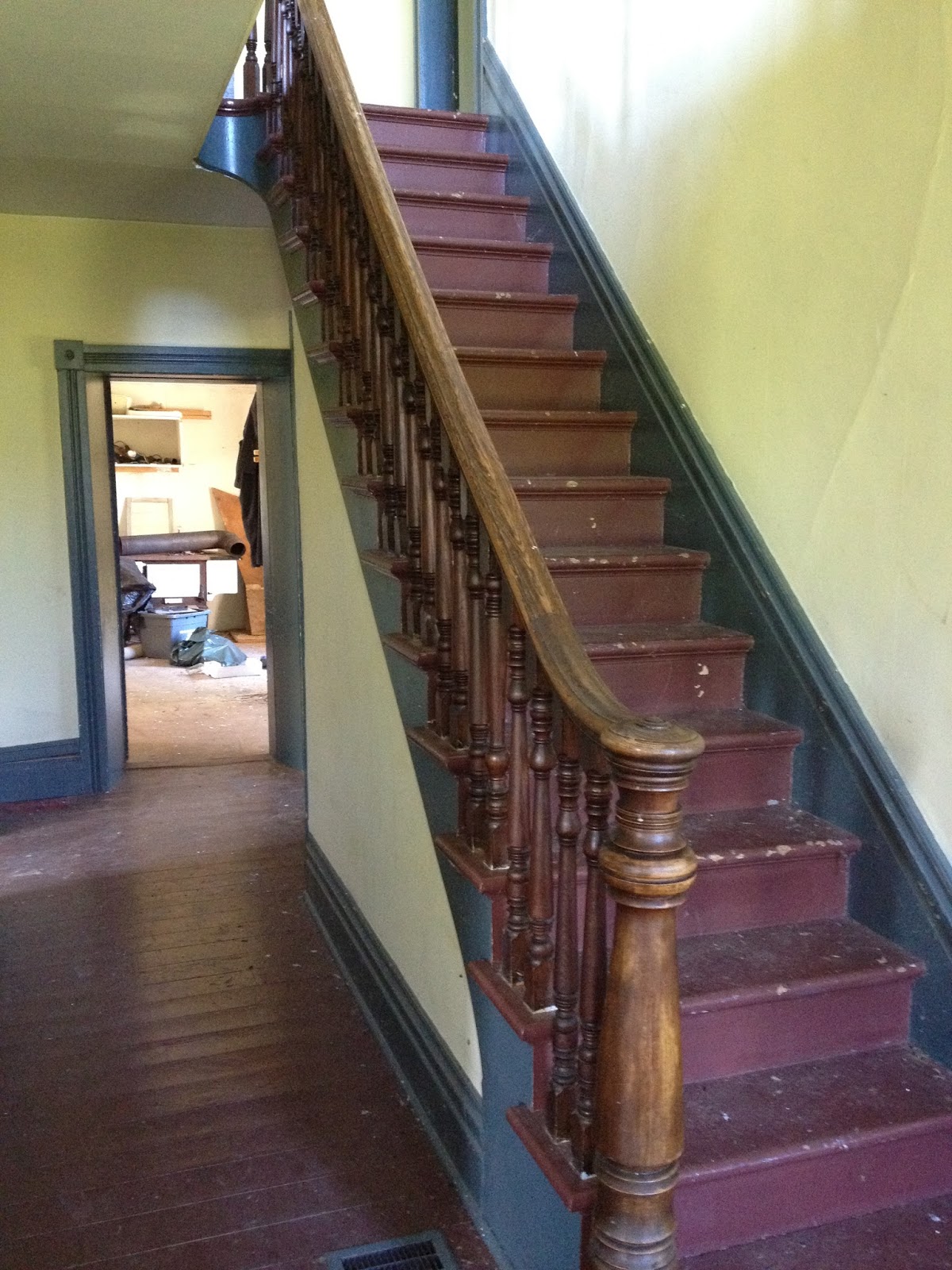
This home is executed on the very typical "Old Ontario Farmhouse" centre hall floor plan, meaning that there is a central stair hall flanked by rooms on either side.  One interesting feature, is that instead of the traditional two room arrangement on the left hand side of the house, there is a large central room accented with a stunning bay window.  The rear portion of the home is given over to the kitchen which was also quite typical of many a farm home.  Capping it all off is a wonderfully aged tin roof that not only offers more durable protection from the elements, it's aged patina also complements the charm of the stone exterior.

Long ago my folks considered purchasing this beautiful home, but we ended up building a cottage instead.  I have coveted it for many years, and consider myself quite fortunate to have at least been afforded the opportunity to photograph and sketch it several times.  If anyone can offer any suggestions of how I might purchase this beauty, I would be most appreciative.  It would make a wonderful home and art/writing studio for me.  I have also included a little video tour I did of the exterior of this charming hope, and I hope you enjoy it.  Please check out my website at sandym70@wix.com.

Thanks for looking, and Happy Canada Day!


Saturday, 27 June 2015

Collingwood's Terminal Building, the Beacon of Georgian Bay


For many, one of Collingwood’s most iconic structures is our majestic “Collingwood Terminals Limited” building standing proudly on the shore of Georgian Bay.  From the moment one crosses the rise in Duntroon with all of Collingwood and Georgian Bay laid out before them, the Terminals stands like a beacon, welcoming all to our beautiful town.  Few however will most likely realize that this was not the first structure of it’s kind to watch over our town.

The present structure, completed in 1930, is actually the third in a series of buildings devoted to the receiving, storage and dispatching of grain arriving by rail and by steamers.  The first structure pre-dates 1870 and little is known of it other than it was destroyed by fire.  It was replaced by a beautiful mansard roofed wooden structure constructed in 1870-1871.  Towering 150 feet over the harbour, it was reputed to have been designed by Frederick W. Cumberland who in addition to being a noted Toronto architect was also the manager of the Northern Railway Company.  A majestic and imposing addition to our waterfront, it’s outer beauty was complemented by the fact that it was indeed practical being entirely cased in iron for safety measures.

The first schooner to use the facility arrived from Chicago on September 16th, 1871 and was named the “Potomac.” It brought with it a cargo of 16,000 bushels of corn which was a mere drop in the bucket as the new terminal storage facility had a minimum capacity of 160,000 bushes.  There are reports that at times there would be as many as 150 schooners tied up in the harbour waiting patiently to unload their cargoes.

But as grain shipments arriving via rail continued to increase, it soon became abundantly clear that this structure was inadequate to meet the requirements of a growing economy. By 1888, the now renamed Grand Trunk Railway began to draw up plans for a new larger structure with a minimum storage capacity of 700,000 bushels.  Plans were drawn, but it wasn’t until 1929 that construction of a new poured concrete structure began.  Completed in 1930, the newly established Collingwood Terminals Limited boasted one of the tallest structures north of Toronto, and an astounding storage capacity of 2 million bushels.


Though rendered obsolete by it’s new concrete cousin, the old structure continued providing service, indeed being leased to a Chicago grain company for several years.  As with most wood structures of it’s imposing stature, it was threatened with fire over the years but each time was saved by the quick actions of the local fire department.  The two terminals stood side by side, a gateway to the bay.  But as the economy began it’s downward fall along with the water levels, this beautiful building was soon facing it’s demise.  Seventy years after construction, the oldest elevator on the Great Lakes was finally torn down in 1937.  Like the grain dust it once held, it’s memory now scattered to the winds of history and time. 


Tuesday, 23 June 2015

From Nottawa to Ninety! Happy Birthday Maxine Frye!


Throughout the years, many of my readers and followers have listened to me lament on the changing definition of the "best friend." While some might think me overly optimistic in my goal, it is only because I grew up with role models who were the perfect definition of that term.

Maxine and Mervyn Frye were not only my grandparent's neighbours in Nottawa, but they were also their best friends.  For almost 50 years, there were morning coffee dates, lunches, dinners and leisurely chats on the front porch lasting late into the evening.  The Frye's were like my surrogate grandparents, and I remember vividly staying with them the day of my grandpa Harold's funeral when I was a boy of 9 years old, playing with my Lego with Mervyn and Maxine as they tried to make the loss of my first grandparent a less scary moment.

I often think of the history that my grandparents, Neil and Reba, and the Frye's shared. Both came to Nottawa in the 1950's with young families, and both saw many transitions throughout the years as their kids grew up, married and had children of their own.  They also shared many sad moments, particularly the loss of Maxine's husband Mervyn in 1988, and the loss of my own beloved grandpa Neil in 1992.  For many years after my grandpa's passing, Maxine my grandma and I would often joke of the occasion when I had received the gift of a fancy German slingshot from our neighbours the Rykerts back in the early 1980's.  It came with very potent (and dangerous) lead pellets, and my grandpa was eager to try it out on scaring off the squirrels that would plunder his bird feeders.  One afternoon he glanced up from his chair (and his National Enquirer) to see a squirrel dangling from one of the aforementioned feeders.  He jumped up so quickly, slingshot in hand that he actually startled both my grandma and I.  He shot a lead pellet at the hapless squirrel only to miss his target (no need to call PETA), but unfortunately did not miss the Frye's aluminum screen door across the street!  I can still recall Maxine saying, "I was sitting watching Wheel of Fortune and then BANG!" She got up to find a neat hole in her door and a pellet on her front vestibule floor!

The other great memory of times spent with Maxine is when she would accompany my grandparent's and I to the church suppers at McIntyre United Church.  We would always joke about the amount of food each of us would eat, and always left with bulging belt buckles.  Usually when we would go back home to Nottawa after such an event, Maxine, my grandma and I would go for our daily walk around Nottawa, something that we had done with regularity since my grandma's heart attack in 1985.  Speaking of the 1980's, it wouldn't be complete if I didn't include my grandpa's favourite nickname for Maxine.  As "The Golden Girls" was one of our favourite shows, my grandpa's nickname for Maxine was Dorothy, something I'm not quite certain she found endearing, ha ha!  Oh well, my grandma was Rose, and I do believe that left me as Blanche, and of course my grandpa as crotchety Sophia, ha ha ha!

Since I've moved away, I unfortunately don't get as many opportunities to see the folks I love as often as I wish I could.  I was overjoyed to received the invitation from Maxine's granddaughter Jennifer on the occasion of her 90th birthday.  The last time I had seen Maxine was in 2010 when I was dealing with my cat Murphy's cancer diagnosis, and unfortunately didn't have a chance for a repeat visit while she still called Nottawa home.

She now lives in a beautiful retirement villa in the town of Walkerton.  It was our first ever trip up there, and I was truly overjoyed to see her after so much time, as she was with me.  We also got to see some other wonderful folks, Willa Rentner, Rose Pierce and Rose Patterson being among those beautiful faces from the past.  I promised to come back soon for a return visit as old friends, "best friends", are truly one of life's greatest gifts.

Happy 90th birthday Maxine, and thank you for being the perfect example of a true "best friend."